Category: Uncategorized

  • Writing the Successful Gun-Hunt Story: Part 2. The Edit

    In Part I I wrote a long form version of a recent deer hunt with my custom Ruger Old Army percussion revolver where I killed a deer with my cast bullets and reloads using a Taylor and Co. conversion cylinder in .45 Colt.  This story has some commercial appeal because:  A. I am using a percussion pistol to shoot a powerful hunting load. B. The Ruger Old Army had a long production run and many Ruger collectors and users know of the pistol. C. I had some modifications made to the gun to allow it to mount a scope sight and also outfitted it with a 14-inch barrel. B. My handloads moved advanced the pistol’s capabilities to successfully use a powerful, but conservative, hunting load that functions well in my revolver.

    The story as first written ran about 2,817 words which is suitable for a chapter in a book, but not for a magazine-length article which most editors of outdoor magazines trim down to 1,800 to 1,500 words. The exercise that I would like you to do is to take the present story and trim it down to 1,800 words. Ultimately I will want you to do this with one of your own stories. I am giving you this one to practice on. In the next exercise I will discuss where and how to use photos.


    Thanksgiving Deer with a 14-inch Ruger Old Army using the .45 Colt Taylor & Company’s Conversion Cylinder 

    Preparing for  the 17th Annual Minnesota Governor’s Opener in 2018, I converted a percussion Ruger Old Army percussion pistol into a scoped .45 L.C. revolver with a 14-inch barrel to have a firearm that would be unquestionably legal for the hunt. Outdoor writers from all over the country are invited to these events,  which is held in a different location in the state each year. This year we were billeted in the Grand Casino in Hinckley, and this is the first time in my life that I had a Jacuzzi in hunt camp.

    I first considered going to the Opener in 2017. Then the regulations stated that percussion revolvers were not legal firearms for deer.  Before the next year’s hunt I ordered a .45 Colt conversion cylinder from Taylor & Co. to allow me to use cartridges in the Ruger Old Army percussion revolver.  I also sent the gun to Master Gunsmith Dykes Reber in North Little Rock, Arkansas, to put a 14-inch barrel on the Old Army and install a sight base to take full advantage of the gun’s capabilities.

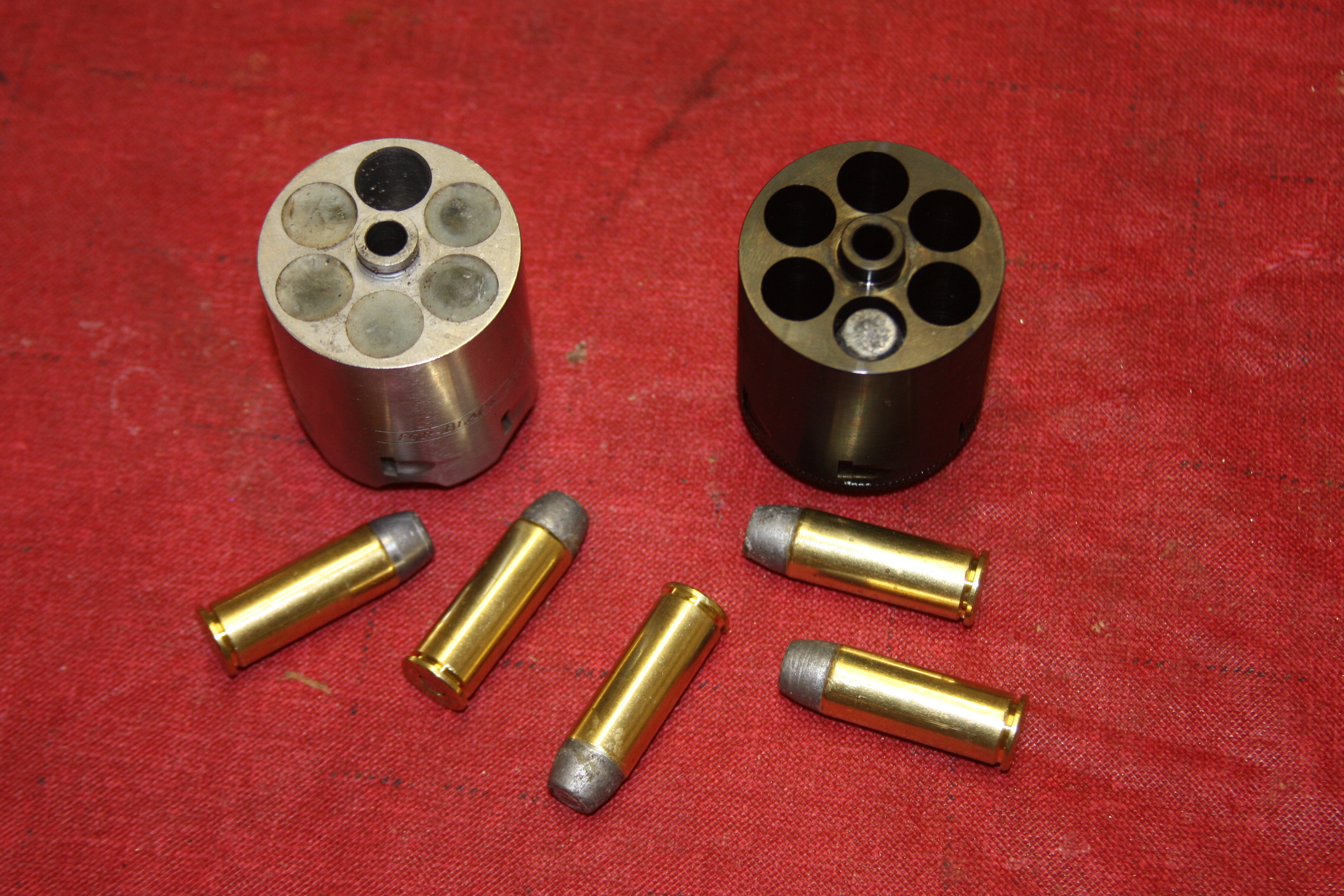
    This conversion cylinder has a removable back plate that contains the firing pins that allow the flat-faced percussion hammer to strike the pins and drive them into the primers and fire the cartridges.  This back plate and the use of a metallic cartridge markedly reduced the amount of powder that I could use in the cartridge. I tried a series of black-powder substitutes, but was not generating the velocities that I wanted  using Kaido Ojamma’s 255 grain flat-nosed bullet.

    Hornady’s reloading manual recognizes two types of .45 Colt reloads. The first are for ordinary 1873 Peacemaker revolvers and their replicas. Then they have a section on loads intended for the stronger Ruger Blackhawk revolvers and Thompson/Center single shot pistols. The lowest category of these was a load of 18 grains of Aliant 700X which registered a velocity of 1262 fps. from my modified Old Army with its 14-inch barrel.  I weighed each bullet and sorted them to provide reloads that would give the best shot-to-shot accuracy in the new Starline cases.

    Loads for the .45 L.C. in the Ruger Old Army with the Taylor & Co. Conversion Cylinder

    Gun           Powder         Bullet         Velocity     Group

    Ruger Old Army .45 L.C. Alliant 700X

    5.6 gr. wt.

    K. Ojamaa’s 255 gr. 718.7 ft/sec 1 ½-in. 25 yards
    Alliant Black MZ 913.9 ft/sec 2-in group
    Hodgdon 777

    25 gr. wt.

    No record 3-in group
    25.6 gr. wt.

    Old Eynsford FFFg

    865.1 ft/sec 3.5-in group
    Black Mag 3 1006 ft/sec 7-inch group
    Alliant 700X

    18 gr. wt.

    1262 ft/sec 1 ½-in group
    Ruger Old Army Percussion Cylinder Hodgdon 777 35 gr. wt. 1039 ft/sec 2-in group


    I found that the 18 grain Alliant 700X loads shot accurately from the pistol and that the fired cases dropped freely from the conversion cylinder indicating that the gun was handling these higher pressure reloads without any problems. The hard lead bullets were cast from mainly wheel-weight metal and gave no leading in the barrel. This is a load that I thought could punch through muscle and bone for even the largest deer and hogs although it is not a .44 Remington Magnum load, and never can be.

    November, 2018, was a busy month. I started on the 3rd with my opening day hunt in Hinckley.  I had taken two guns. My primary one was a Davide Pedersoli Mortimer flintlock fowler which I had loaded with a patched round ball and 100 grains of Olde Eynsford FFg black powder. Being a flintlock, its ignition was problematic in wet weather, so I was glad to have the Old Army with its water-proof cartridges as a back-up.

    At almost last light there were close shots in a pasture next to the property I was hunting.  A large deer, it was too dark to see if it was a buck or doe, briefly walked into the edge of my shooting area and stood for a few seconds. Before I could put my fowler down and pick up my scope-sighted pistol, it bounded away into the woods. That ended the Governor’s Opener for me, and I went home empty-trucked.

    Once home, I had a few days to get ready for my drive down to the Miami Book Fair which is an annual event held by Miami-Dade College at the Wolfston Campus in downtown Miami. After four days in Florida I drove back in time to cook turnips, a sweet potato soufflé and make dill deer potato salad to contribute to Thanksgiving Dinner at my sisters (see my softcover books for recipes).  Even though this was a somewhat rushed-up meal, there was certainly enough to eat and we had many of our traditional foods on the table.

    Full, but not stuffed, I took a power nap to help keep me sharp on the stand.  At about 3:00 P.M.  I grabbed my Old Army and walked down my trail to my food plot, some 400 yards from my house. If it were not for the trees now growing in the old cotton fields, you would be able to see my house from the stand. My plan was to sit until dark to see if anything came out.

    This was my 12th deer hunt and 8th with the pistol this season. This had been a grim season for me. It was not that I was refusing deer waiting for a trophy buck; I was just not seeing any deer within range of my short-range shooting equipment. With an ideal shot I could reliably take a deer at 75 or perhaps even at 100 yards with the scoped revolver, but the few deer I had seen were beyond my self-imposed range limit.

    It was nearly dusk and a buck stepped out into the food plot to my left. This was a small buck, about a 2-year-old and was sporting four points on one side and three on the other.  The buck nibbled on some of the emerging oats and winter peas that were sprouting in the plot, but made steadily for the some corn I had put out in front of the blind.  I had time to consider if I would take that deer or not.  I was down to the last few packages of deer and wild hog in my freezer, and I needed some meat.

    Another consideration was that although we may take a dozen deer in Georgia only two can be bucks, and I know that I have at least two much better bucks on the property. If I took this small deer now, that would preclude me from perhaps shooting a trophy deer later in the season. Nonetheless, I had made my decision. If the deer approached close enough I would take it.

    I put down the Mortimer Fowler and picked up the Old Army. The highest percentage shot that I would have with the pistol was for the spine which would drop the deer and allow me to make an easy retrieve in the fading daylight. I silent cocked the gun moving the cylinder from an empty chamber to a live round and carefully rested the barrel on the shooting rail of the stand. This steadied the gun. I now had to wait until the deer was lined up for a spine shot.

    Ultimately the deer, at 40-yards, moved into the desired position, and I found the crosshairs in my scope. Even with the dimming light I could align the vertical crosshair parallel to the buck’s backbone. There is always a temptation for me to shoot too quickly at a piece or game, and I had to purposefully calm myself down. All the factors were in my favor, and it was time to take the shot.

    The hammer fell and the .45 L.C. round fired sending Kaido Ojamaa’s 255 grain hard-cast bullet on its way.  I could not tell exactly where the round hit, but the deer was down in its tracks.  It was still moving its legs, and I quickly gave it a finishing shot through its lungs which killed it seconds later. I was happy and relieved that this deed was done.

    What did this experience show that was not already well-known to most people? A. the Ruger Old Army is a strong capable percussion revolver whose usefulness can be enhanced by using a conversion cylinder to enable it to shoot .45 Colt Keith-type loads. B. The addition of a scope base and long-eye-relief pistol scope not only enhanced better target acquisition, but also enabled a precision shot to be taken on dimly lit subjects. C. The added weight caused by the addition of the scope and the 14-inch barrel made the gun comfortable to shoot, even with powerful hunting loads. D. The use of cartridges in the revolver enabled it to be reliably used in damp or wet weather, which might hinder a percussion pistol because of water contaminating the priming powder in the cap. E. The long barrel without a front sight allows this gun to be carried with the barrel thrusts through a belt or sash, removing the immediate necessity of having a holster rig custom-made for the pistol.

    Create Your Own Job Security

    Generally available for special promotion price of $10.99.

    $10.99


  • Writing the Successful Gun-Focused Hunting Story: Part I The Story

    As a person who has been writing and selling stories about guns and hunting since the 1970s, I would like to demonstrate how to craft a successful gun-focused hunting story.  In any hunting story the first thing that needs to be established is the focus of the story. Is it to be primarily about a firearm? Or is it to be about a person, place or variety of game. Any of these subject materials may be used, but before the story is even started its primary focus needs to be decided upon.

    The second thing to be decided upon is who is telling the story? ls this to be a first-person story as in the typical “Me and Joe” story where you describe what you and your hunting buddy did on a given trip? Is it to be more about the gun and its statistical attributes that you have discovered through a typical “Gun Test” type of coverage where you take the firearm through its paces with a variety of ammo and shoot it at different ranges? Is this to be a “Hunt Test,” where you use the gun to take a piece of game or a balance between the two as a “Gun-Hunt Test.”

    The long form of “Me and Joe” stories are now disfavored in the marketplace. If an editor wants this type of story he is likely to republish some famous long-dead author, rather than take a new piece from you. In essence you are competing against every outdoor author who ever wrote as well as your contemporaries. You can go ahead and write such a story to get all of your thoughts on the subject down on paper, but likely the editor will want more like 1,800 words and more photos, rather than your 3,000 word piece which is now considered almost an epic-length story.

    In the example I am going to use, I write a long-form outdoor story to illustrate some possible elements that might be used and in a later exercise you will edit this story down to 1,500 words by removing the less significant portions of the story. This is what an editor would call, “cutting the fat out of a story.”

    The first thing that a writer must do is to get something down on paper. That is a rather obvious statement, but is a real hang-up for some people. They have a tough time committing to a project that is going to require them to do some real mental work. An accurate description of the events described in the following story is: On Thanksgiving afternoon I took a modified Ruger Old Army percussion revolver with a scope sight and 14-inch barrel and using .45 Colt  reloads shot from a Taylor & Co.’s conversion cylinder killed a young buck in my food plot.

    Some people cannot get much beyond that sentence in attempting to put a story together. While an accurate statement of the events suitable for a police report, this description is not sufficient for an outdoor story, unless this is a concluding line in a story that is focused on say, reloading for the .45 Colt  Imagine in a magazine one photo, this line followed by three blank pages.  The reader of the magazine demands much more than that.

    What does the reader expect when he picks up a magazine article? He expects : A. the truth unless the story is identified as fiction, B. a readable story, C. to be told something that he did not know, D. some difficulty overcome by the author and E. a satisfying conclusion.

    Here is the story. Read it and identify the various sections as I describe them. My comments are in italics.

    Thanksgiving Deer with a 14-inch Ruger Old Army using the .45 Colt Taylor & Company’s Conversion Cylinder 

    State laws vary on what guns may be legally used to take deer which caused me to convert a percussion Ruger Old Army percussion pistol into a scoped .45 L.C. revolver with a 14-inch barrel to participate in the 17th Annual Minnesota Governor’s Opener 2018 Hunt in Hinckley, Minnesota. These hunts have been a Minnesota tradition for that has been continued through different administrations to promote outdoor activities in Minnesota. Although the general concept started with deer hunting, it has been expanded to also include a Pheasant Opener and Fishing Opener that works on the same format.

    The first sentence in a journalistic manner tells the who, what, when, where, why and how of the story that is to follow.

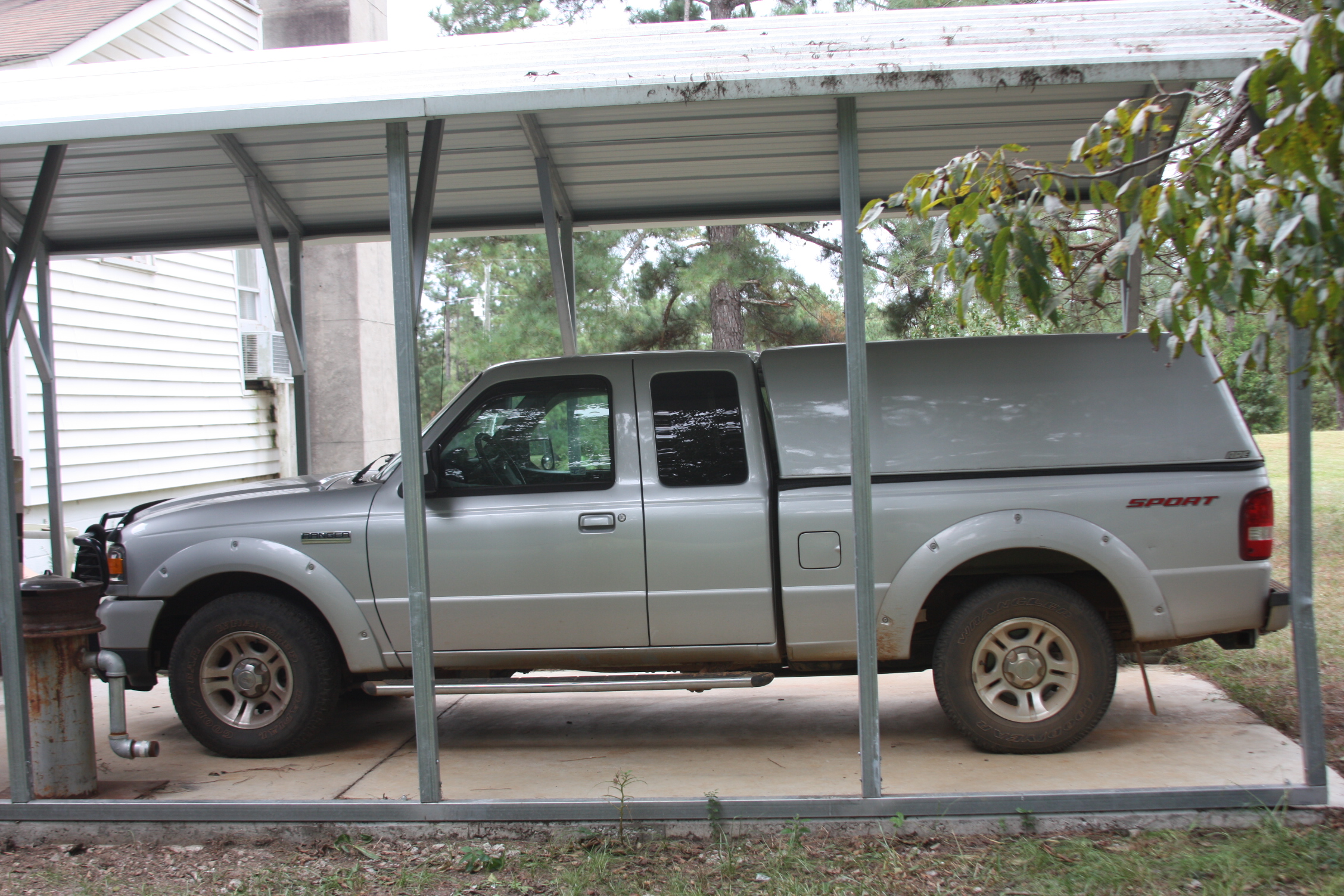
    Outdoor writers from all over the country are invited to these events, housed in a different location in the state each year and taken hunting or fishing by sponsoring organizations such as the Minnesota Deer Hunters Association.  For this event we were billeted in the Grand Casino in Hinckley, and this is the first time in my life that I had a Jacuzzi in hunt camp. I was glad to see it  and used it to help restore some mobility in my legs after the day and a half drive up from Georgia.  I drove my 2011 Ranger Ford Sports Truck up with the expectation that I would have a big Midwestern deer to take home.  I was not looking for a trophy deer – a good-sized corn-fed doe would do just fine.

    The first time I had considered going to the Opener, the regulations stated that percussion revolvers were not legal firearms for taking deer. For this reason I postponed the hunt until the next year. This gave me time to get a .45 Colt conversion cylinder from Taylor & Co. to allow me to use cartridges in the Ruger Old Army percussion revolver.  This also gave me time to send the gun to Master Gunsmith Dykes Reber in North Little Rock, Arkansas, to put a 14-inch barrel on the Old Army and a sight base so that I could take full advantage of the gun’s capabilities.

    This answers the question why did I have such a gun built and who did the work?

    This conversion cylinder has a removable back plate that contains the firing pins that allow the flat-faced percussion hammer to strike the pins and drive them into the primers and fire the cartridges. This back plate uses a little more than a quarter-inch of space in the rear of the cylinder and reduces the over-all chamber length. When you add the space taken by the cartridge case, I found that I could not load more than 25 grains of Hodgeon’s Triple7even in these cases, although I could load 37 grains of powder in the percussion cylinder using Kaido Ojamma’s 255 grain flat-nosed bullet. I also tried other black powder substitute loads that you can see in the table below. Some worked better than others, but they were still not producing the velocities/energies that I wanted to take on a big Minnesota whitetail.

    This covers the operational characteristics of the conversion cylinder and the load that I used. This nuts and bolts material is what people who read about guns thrive on. It is akin to a baseball fan’s knowledge of the Red Socks winning the World Series.

    Hornady’s reloading manual recognizes two types of .45 Colt reloads. The first are for ordinary 1873 Peacemaker revolvers and their replicas. These include lower velocity Cowboy Action Loads and top out at about 900 fps. with 255 grain bullets. Then they have a section on loads intended for the stronger Ruger Blackhawk revolvers, Thompson/Center single shot pistols and the like. The lowest category of these was a load of 18 grains of Aliant 700X which registered a velocity of 1262 fps. from my modified Old Army with its 14-inch barrel. This was an accurate load with Ojamaa’ cast bullets. I enhanced these bullets’ capabilities   by weighing each one to provide a reloads that would give the best shot-to-shot accuracy when loaded into new Starline cases.

    Loads for the .45 L.C. in the Ruger Old Army with the Taylor & Co. Conversion Cylinder

    Gun           Powder         Bullet         Velocity     Group

    Ruger Old Army .45 L.C. Alliant 700X

    5.6 gr. wt.

    K. Ojamaa’s 255 gr. 718.7 ft/sec 1 ½-in. 25 yards
    Alliant Black MZ 913.9 ft/sec 2-in group
    Hodgdon 777

    25 gr. wt.

    No record 3-in group
    25.6 gr. wt.

    Old Eynsford FFFg

    865.1 ft/sec 3.5-in group
    Black Mag 3 1006 ft/sec 7-inch group
    Alliant 700X

    18 gr. wt.

    1262 ft/sec 1 ½-in group
    Ruger Old Army Percussion Cylinder Hodgdon 777 35 gr. wt. 1039 ft/sec 2-in group


    My old Hurter’s Super Model single-stage reloading press is a beast of a press. By the time I bought it in 1973 in Alaska, the old press had already been used to reload tens of thousands of rounds by a GI who did custom reloading for his buddies.  As a consequence, it came with a box of assorted shell holders for almost any caliber used by Alaska’s shooters and hunters. Fortunately, it also came with an adapter to enable it to take RCBS and Redding reloading dies, so keeping it going to run the few hundred hulls that I do a year presented no problems.  It’s slow, but it gets the job done.

    This was included to illustrate the point that reloading presses made years before some of you were born can still give excellent results.  You do not need the newest thing available to reload these cartridges.

    I found that the loads shot accurately from the pistol and the fired cases dropped freely from the conversion cylinder indicating that the gun was handling these higher pressure reloads without any problems. The hard lead bullets were cast from mainly wheel-weight metal and gave no leading in the barrel. This is a load that I thought could punch through muscle and bone for even the largest deer and hogs. It is not a .44 Remington Magnum load, and never can be. This is the direct equivalent of some of Elmer Keith’s hot .45 Colt reloads that he started writing about in the 1930s.

    This paragraph ranks the power of my favored reload with those produced in the past and with the .44 Remington Magnum.

    My use of muzzleloaders, which are mostly single-shot guns, has taught me the value of one well-placed shot, rather than relying on multiple hits do down a piece of game. Although revolvers do have multi-shot capabilities, I try to drop the game with the first shot and then use another if necessary to end its struggle. This is exactly the scenario that played out on my Thanksgiving hunt.

    This is a personal plug that a person needs to learn how to shoot accurately and put that first shot where it needs to go.

    November, 2018, was a busy month. I started on the 3rd with my opening day hunt in Hinckley. I drove  to my host’s house and was taken to the blind where I was to hunt. It was a frosty morning, but I was well dressed. Rain and snow had been threatened for the day as a new weather system was moving east, but it had not yet arrived. Although this built-up stand had a platform and seat, it had no top.

    I had taken two guns. My primary one was a Davide Pedersoli Mortimer flintlock fowler which I had loaded with a patched round ball and 100 grains of Olde Eynsford FFg black powder. Being a flintlock, its ignition was problematic in wet weather, so I was glad to have the Old Army with its water-proof cartridges as a back-up.   In the Management Area where I hunted I could take only one deer, but it could be either a doe or buck. Either would be fine, I was just hoping for a good-sized deer.

    This paragraph explains why I take two guns into the deer stand. Wet weather can quickly drown a flintlock’s exposed ignition system.

    I stayed in the stand from dawn until 1:00 P.M. I was stiff-legged and very tired from having had very little sleep the night before. I was kept awake by the mental excitement concerning the next day’s hunt.  I elected to go back to my Casino Hunt Camp, take a nap and return at 3:00 and stay until dark. This I did and returned much refreshed. At almost last light there were close shots in a pasture next to the property I was hunting.  A large deer, it was too dark to see if it was a buck or doe, briefly walked into the edge of my shooting area, stood for a few seconds and before I could put my fowler down and pick up my scope-sighted pistol, it bounded away into the woods. That ended the Governor’s Opener for me, and I went home empty-trucked.  A radio broadcaster who was hunting another part of the property had similar luck. Neither of us took a deer from that hunt even though he stayed in all day.

    Once home, I had a few days to get ready for my drive down to the Miami Book Fair which is an annual event held by Miami-Dade College at the Wolfston Campus in downtown Miami. After four days in Florida I drove back in time to cook turnips, a sweet potato soufflé’ and make dill deer potato salad to contribute to Thanksgiving Dinner at my sisters (see my softcover books for recipes). Mary was recovering from a bout with near pneumonia. Two of her daughters, Marsha and Linda came down and cooked a turkey and made the dressing for our holiday meal. Even though this was a somewhat impromptu and rushed-up meal, there was certainly enough to eat and we had many of our traditional foods on the table.

    After the meal I left Hector, my Lab, to continue to enjoy the festivities with Hera, my former dog who abandoned me and took up with my sister and brother-in-law and their dog Boomer. These three get along well and leaving Hector in such good hands allowed me to go to the woods without Hector playing his favorite game, Finding Hovey in the Deer Woods.

    These two paragraphs give some personal insight into my character and the nature of this hunt as an almost accidental happening on Thanksgiving afternoon. The tie-in with the story is that this documents my good fortune on this day.

    Full, but not stuffed, I took a power nap to help keep me sharp on the stand.  At about 3:00 P.M.  I threw on a German camo jacket, an orange vest, grabbed my Old Army and walked down my trail to my food plot, some 400 yards from my house. If it were not for the forests now growing in the old cotton fields, you would be able to see my house from the stand. My plan was to sit in the stand until dark to see if anything came out.

    By this time it had been my 12th deer hunt and 8th with the pistol this season. If you should think that we gun writers get to go to all the good places and always get a trophy deer each time we go out, this is not the case.  This had been a grim season for me. It was not that I was refusing deer waiting for a trophy buck; I was just not seeing any deer within range of my short-range shooting equipment, i.e. a crossbow, flintlock fowler and the Old Army. With an ideal shot I could reliably take a deer at 75 or perhaps even at 100 yards with the scoped sighted revolver, but the few deer I had seen were beyond my self-imposed range limit.

    This documents a little bit of drama and trial. My getting this deer was not a one-hunt one-kill affair, but the culmination of a long series of attempts.

    It was coming up towards dusk and a buck stepped out into the food plot to my left. This was a small buck, about a 2-year-old and was sporting four points on one side and three on the other. One side of the rack had been somehow deformed and had an odd kink in the horns.  I spread corn in front of that stand from time to time during the hunting season, whether I hunted the food plot or not. This way deer would come to check out the spot and seek to come earlier to get first dibs at any corn that happened to be there.

    This buck, for once, did as predicted. It nibbled on some of the emerging oats and winter peas that were sprouting in the plot, but made steadily for the corn.  I had time to really consider if I would take that deer or not.  The Quality Deer Management folks would maintain that you should never shoot such a deer, but let it grow and take a doe instead. I was down to the last few packages of deer and wild hog in my freezer and I needed some meat.

    Why  I shot such a young deer is now explained and in the next paragraph I discuss the possible consequences.

    Yet another consideration is that although we may take a dozen deer in Georgia only two can be bucks, and I know that I have at least two much better bucks on the property. If I took this small deer now, that would preclude me from perhaps having to refuse a chance at a much larger deer later in the season. Nonetheless, I had made my decision. If the deer approached close enough I would take it.

    These two paragraphs add a little tension to the story, rather than flatly stating, “When the deer got close enough I shot it.”

    As the deer walked closer and closer to my sure-kill zone, I put down the Mortimer Fowler and picked up the Old Army. The highest percentage shot that I would have with the pistol was for the spine which would drop the deer and allow me to make an easy retrieve in the fading daylight. I silent cocked the gun moving the cylinder from an empty chamber to a live round and carefully rested the barrel on the shooting rail of the stand. This steadied the gun. I now had to wait until the deer was lined up for a spine shot.

    These are short-range hunting tools and I was holding out for my best chance for a quick kill.

    Ultimately the deer, at 40-yards, moved into the desired position, and I found the crosshairs in my scope. Even with the dimming light I could align the vertical crosshair parallel to the buck’s backbone. There is always a temptation for me to shoot too quickly at a piece or game. I had to purposefully calm myself down before I started my trigger pull. If I ever get to the stage that I do not get excited when I am about to take a shot, I will give up hunting. Now all the factors were in my favor, and it was time to prove my concept and take the shot.

    This is a hunting and shooting tip.

    The trigger was slowly squeezed, the hammer fell and the .45 L.C. round fired sending Kaido Ojamaa’s 255 grain hard cast bullet on its way.  I could not tell exactly where the round hit, but the deer was down in its tracks.  It was still moving its legs, and I quickly gave it a finishing shot through its lungs which killed it seconds later. I was happy and relieved that this deed was done.

    Why I shot twice and why multishot muzzleloaders are useful in the field, although prohibited in some states.

    All of my camera and deer retrieving gear was back at house. I wanted to shoot some video about the hunt, and rushed back to get my cameras and Brother-in-Law, Charles Eddins, to help me load the deer. I wanted to load it into my Ford Ranger pick-up truck so that I could take it to the processor that night. Although I usually clean my own deer, I like to have one deer a year done by a professional processor,  in order to get some packages of cubed steaks as well as  ground deer and roast.

    I am now 76 and this damn age thing is starting to tell on me. I am losing muscle strength and cannot load a 125-pound deer into the back of my Ranger by myself. Charles is about 5 years older and has back problems and between us we could not get the deer on the truck. He helped me take the video and still photos in the dark with light provided by my truck’s headlights.

    True confession time. I am not the guy I once was. I am not embarrassed to admit it. 

    Charles had a utility trailer with a back that could be lowered to the ground that enabled me to pull the deer off the plot onto the trailer.  Then we reversed the trailer and used the inclined back of the trailer to pull the deer higher onto my tailgate and  into the back of the truck. By using this two-stage technique we were able to get it aboard my truck and to my processor in town. For some reason the lights on the utility trailer did not work, and I did not want to take a chance on pulling that trailer to town in the dark.

    A tip on how to load a deer using the drop back of a utility trailer.

    When I am hunting alone, as I most often do, I use my Snapper lawnmower with the mower deck removed to pull either a shed or cart as close to the kill site and I can get them. Then I only have a four-inch lift to load the deer and take it to my tripod where I can quarter it and put it in a chilled cooler or on ice until I can package it the next day. I have done several videos about different aspects of deer processing and cooking which you can view on YouTube.

    What did this experience show that was not already well-known to most people? A. the Ruger Old Army is a strong capable percussion revolver whose usefulness can be enhanced by using a conversion cylinder to enable it to shoot .45 L.C. Keith-type loads. B. The addition of a scope base and long-eye-relief pistol scope not only enhanced better target acquisition, but also enabled a precision shot to be taken on dimly lit subjects. C. The added weight caused by the addition of the scope and the 14-inch barrel made the gun comfortable to shoot, even with powerful hunting loads. D. The use of cartridges in the revolver enabled it to be reliably used in damp or wet weather, which might hinder a percussion pistol because of water contaminating the priming powder in the cap. E. The long barrel without a front sight allows this gun to be carried with the barrel thrusts through a belt or sash, removing the immediate necessity of having a holster rig custom-made for the pistol.


  • Use the Old Movie Serial Approach to Get Returning Traffic to Your YouTube Videos

    Ruger 14 (2)

    This is a Ruger Old Army percussion revolver after it was modified by Master Gunsmith Dykes Reber. This work and the modification of the gun was the subject of one of the YouTubes in this series.

    Those of us of a Certain Age remember the movie serial shorts that were usually part of a Saturday movie double feature schedule. These were typically westerns and always left the viewer with a cliff-hanger that would be resolved the next week only to be replaced by another, and so on for 10-weeks or so. This same approach was adopted by the later soap operas on TV, and is still being employed today to attract returning fans.

    Ruger Old Army with some of its GA trophies

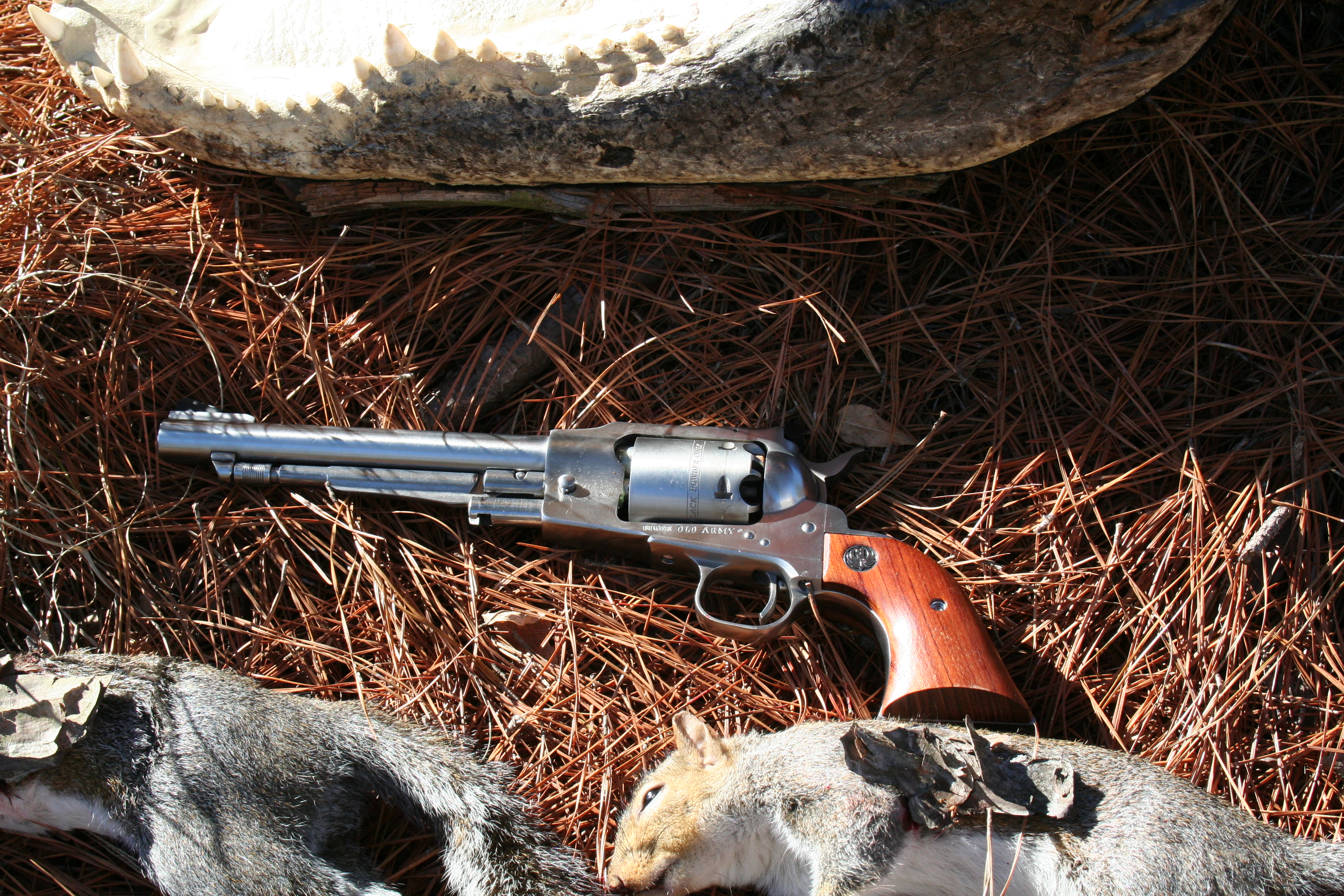
    The Ruger Old Army and I had previous adventures such as taking a Georgia alligator with the gun as well as squirrels and deer, which likewise produced several videos.

    As an outdoor writer it often takes me a period of time to get a new firearm, develop hunting loads for it and ultimately take a piece of game. At each of these stages I will often produce a YouTube video about 15-minutes long about the event. My viewers find it interesting to see a project being developed instead of having a one-video blasts of the final project and its climatic hunt.

    Ruger Percussion and .45 LC conversion cylinders

    A new approach, and more videos, were allowed when I purchased a conversion cylinder to allow the percussion pistol to use .45 L.C. cartridge ammunition and I developed effective Cowboy Action and hunting loads for the gun.

    If you are a creative person, take your audience along with you as you develop your painting, sculpture, work of fiction or whatever it is that you do. The more exposure and the more of you that can be put into these videos, the better your audience will come to care for you as a person. This will result in not only more views, but also more followers and perhaps even contributors if you at some stage go to Kickstarter or Go Fund Me for community support.

    The climatic video shows the hunt and also some of the activities that took place in previous episodes.

    In this approach it pays to be honest, and if you sometimes fail, show those as well as your successes to provide a learning experience for your audience. None of us are perfect. We will all make errors in our lives of all sorts. That is what makes us human and differentiates the best of YouTube videos from commercially produced paid advertising.  People click through paid ads every second, but they will stay through an honest effort to fix a car, paint a house or even write a novel.

    Consequently, at each meaningful stage in your project connect with your audience. Tell of your struggle, document your successes and by example teach them something along the way. If not obvious, at the end of your video have a “coming up” section as you describe what you are going to be next.

    Finally, at the very end of your project do a “wrap up,” on that item. Then you can announce that it is for sale and relate when and how people may bid on it or see you perform, where they may order the book, etc. As usual, you can also offer a teaser about your next project. This serial YouTube process keeps your audience engaged, prolongs their interests in you as a person, promotes your public engagements and ultimately increases exposure and income.

    Japeg Bk. 6 c

    This event will now permit me to complete my forthcoming e-book, Hunting With Small Muzzleloading Revolvers which should be available in a few months.

    Create Your Own Job Security

    Generally available for special promotion price of $10.99.

    $10.99
  • Ford Ranger, Miami Book Fair, Food and Fun from Minnesota to Florida

    IMG_1866


    Mn Gov Hunt 2018Early November found me in Hinckley, Minnesota, attending the Governor’s Opener Deer hunt which was run out of the Grand Casino. After returning home for a week, my 2011 Ford Ranger Sports truck was off again for a 600 mile drive to the Miami Book Fair with an overnight stopover in Orlando to visit some cousins and drop off a knife that I refurbished for their dad.

    As the book fair was a weekend event, this was a workday-school day event for my nephews, and our time together was limited. Being in every respect but blood an older uncle to these two, we had a lot of catching up to do. Michael, the dad, had worked through some life events which included a divorce.  He and his son Tate were staying in Michael’s parent’s house while his dad, Bob, was spending the summer at the family lake cabin in Michigan. Bob’s wife had died two years before, and so the entire family had undergone some profound readjustments.

    Michael had finished a college degree, got a job in Florida’s now booming construction industry and is  working his way up in the company’s structure from a procurement officer to a site manager. His life now has a meaningful purpose, his personal issues are under control and he said that there had never been a more fulfilling part of his life. From everything that I could see this is absolutely true. Tate is now in the 10th grade staying with his dad and growing up to be a handsome young man who is starting his journey on figuring this life thing out.

    Ben's front cover Create Job
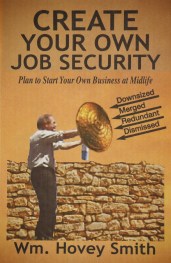
    Available from Amazon.com and bookstores. I come off something like Petronius  in Shakespeare’s Macbeth when he sends is son off into the world with words like, “be not a borrower or lender be.” Most of my council was based on my new book, Create Your Own Job Security: Plan to Start Your Own Business in Midlife in which I discuss the premise that anyone, anywhere, at any time can start their own businesses to satisfy their financial needs and life goals.

    This is a heavy trip to lay on a 10th grader. Michael, Tate and I had last interchanged two years previously when I had passed through on the way to a successful hog hunt in South Florida. We had, and have, an excellent relationship mostly because I see as my input helping these two finding their own way through life, rather than coming down too hard on your should do this or that. The two and three generations divide between us give us different perspectives. I was, and am, and reader. Them not nearly so much, and here I was thrusting a 200-page book at them and suggesting that they not only read it, but implement some of its principles.

    My challenge was how to get this done. First, I wrote a quite different business book. It starts off more like an adventurous autobiography with me pulling fuses from a ton of lit explosives that our helicopter had crashed on top of in 30 degrees below zero weather in Copper Center, Alaska.  I further use storytelling to illustrate the business principles that I describe. It is an asset that this book does not look like, or read, like a typical text book. I wrote it to be a business book for the non-business major to provide an interesting read, while also covering the nuts and bolts of issues of how to name a business, file for a U.S. trademark, register a copyright, apply for a patent, find meaningful partners and finance new ventures.

    As so often occurred in Shakespeare’s plays, I had to hatch a plot that would require both of them to do more with the book than just page through it. I gave each of them autographed copies of the book. I gave an additional copy to Tate to give to his teacher to review. I suggested that Tate volunteer to do a book report on the book with the title of How Storytelling Can be Used to Illustrate Business Principals. If carried off successfully this could be an A+ book report. However, that report may never be written in Middle School because of rigid curriculum guidelines that have been enacted in many school systems. The books that will be read in given grades, the topics that will be covered and even the methods of presenting them are often out of individual teachers’ hands. They might get in real trouble by making unauthorized changes in what they present to their students and how and when they do it.

    This is quite different from when I was in school in the 1950s. Teachers had much more latitude in their classes. In my small town high school with a graduating class of a few over 200 we produced doctors, lawyers, professional people, those who went into performing arts and I was on the same debating team with Georgia’s current Governor, Nathan Deal, who was also a childhood friend. In short, we were not ill-educated and even used the then new remote teaching methods on TV screens. When teachers can innovate and inspire, their students benefit.

    Tate’s major life task at the moment is to discover what line of work that he enjoys so much that he would do it even if no one paid him and devise a way to make money at it.  I don’t care what that particular work might be. It might be in the arts, the sciences or in some aspects of human relations. It could even be a combination of things where the arts converge with science, as with medical illustrations. It is also entirely possible that he has not found out what his passion is because he has not been exposed to it. We talked about his liking for history and art that combined could be archeology which is also an interest of mine. I chose geology as a profession because of increased work opportunities.  At the time the only archeological positions were with universities and someone had to die before a faculty position might be available. In the meantime, the archeology students worked like slaves on digs and oftentimes had to pay to be attached to meaningful excavations.  Now, because archeology must be done prior to major construction projects, there are many more openings in the field, although the basic work is no less hard and typically very gritty.

    The Ford Ranger Sports Truck

    Since my wife died I do not need, or want, a large truck for my typically solo hunting and travel adventures. The V-6 Ranger with its 4-L engine had a heavy-duty suspension which enables me to traverse most roads without any problems even if it does not have four-wheel drive. I increased its utility by adding a detachable winch, which I left home on this all-highway trip, a solid-sided bed cover to enable me to protect my books and a steel pipe fount-end guard to help deflect deer. The V-6 engine in powerful enough to sustain 80 mph highway speeds, particularly since I was carrying a very light load and not towing a trailer. The smaller size truck platform is also more nimble in traffic and much easier to park than its full size relatives, like the Ford 150. As the 2011 was the last year of production for the old model Ranger, the bugs had been worked out of the truck.

    The engine, with 75,000 miles, has given me no problems. I had the front-end aligned and put new rear tires on the truck prior to the trip to Minnesota.   Thus far, all is progressing very well. I had a latch failure on the tailgate, but that was a quick fix. The only other things that have happened to the truck were to replace the taillights which are quite fragile and are unprotected.  I should have had a protective cage put over those when I did my modifications on the truck.

    Thus far the engine uses no oil and the gas mileage is reasonable, but not as good as some of the smaller engines offered on the Ranger or the more modern engine used in the reintroduced Ford Ranger that was announced in in November of 2018.

    The Book Fair

    Miami Dade college sign

    Intermittent rain and sometimes heavy thunderstorms dogged me on the way down The Florida Turnpike and I-95 to Miami. My hotel, the Eurostars Langford, is located in downtown Miami about four blocks south of the site of the exhibition which is on the campus of Miami-Dade  College .  It was held in an open block with streets that were lined on both sides with colorful tents. Compared with the Frankfurt Book Fair that I attended a month ago which was an enormous affair hosted in six multi-story buildings surrounding a plaza, the physical set up seemed to be more like a combined  yard sale and street fair.

    When I arrived on Wednesday the rain had not been nearly as bad in Miami as on some sections of the road that I had traveled. Some exhibitors were putting out their books, but most appeared to be waiting to do it the following morning, as the fair officially opened at 10:00 AM. The group that was exhibiting my book, Okir Publishing, which is based in Wyoming with offices in California, was not there; although their tents and banners had been erected. I had paid to have my book exhibited for the three-day event and it would be, whether the hosting organization made it to the fair or not. As it turned out, the Miami Book Fair has an Author’s Row where individual authors may rent booth space for $350, and exhibit all of their books, whereas I paid more than that for Okir to show only one title. I will certainly take advantage of that option next time I come to the event.

    The Eurostar Langford offers a European breakfast option, but it was not included with my room. I could have had their breads and coffee, but sought out something more Miami. I found it at the next street corner where fruit and vegetable smoothies were made and they also had empanadas which are a fried, or baked, bread fold-over that are filled with either beef, pork or ham and cheese or spinach and cheese. Think of an apple tart filled with meat, and that would be a close approximation of an empanada.

    Opening time arrived at the Fair and no one from Okir was at the exhibition space; however, two other authors were. We displayed and talked about our books to the morning crowd which included school classes being escorted through the exhibit by their teachers who took advantage  kid-friendly events hosted at the fair. This was also free admission day, and numbers of Miami-Dade College students passed through the exhibits. These students are in the demographic that I pitch my book to, and I had a good reception and results. Numbers of authors were holding signings and giving away their books and these were being collected by the students. I went to sell books, not give them away, so I referred potential student customers to Amazon.com where they could get either softcover or e-book versions of my book. A number of the students remarked that I was approaching them at exactly the appropriate time, as they were starting to plan out the remainder of their lives.

    About 1:30 PM, I decided to do a walk about and find some lunch. I also wanted to see if I could wrangle  interviews with the print or film media, perhaps make some sales to the college book store or get contacts with the business department about giving business lectures. I was not successful, but cards were accepted to be passed on. CNN was there to do author interviews, but all of their authors were already lined up.

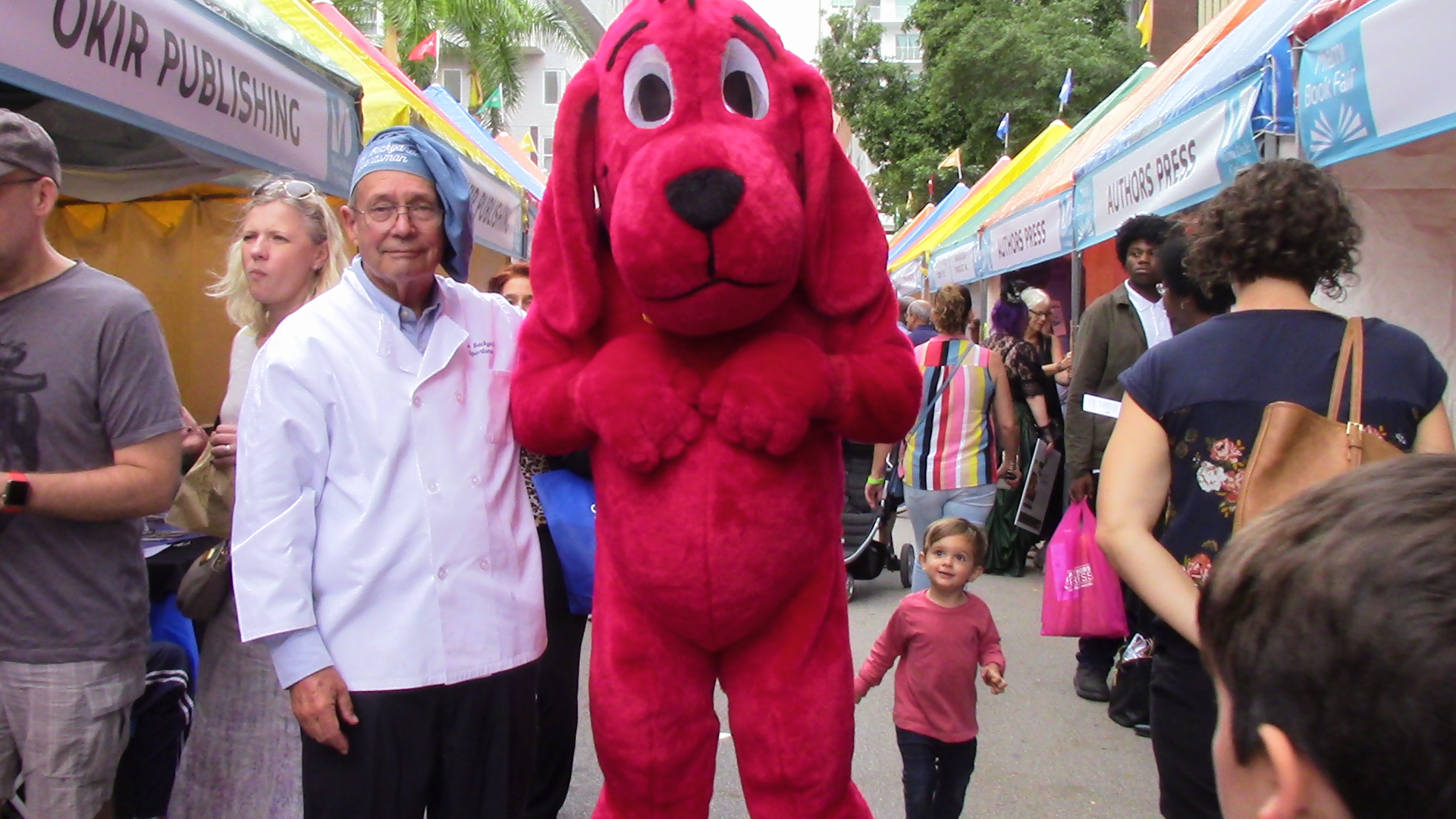
    Hovey with passing character Miami Book fair            When I returned, two representatives of Okir had appeared and were putting out the books they published and those they had arranged to exhibit for other authors. The two copies of the books that I had sent surfaced. While they arranged their exhibit I sat behind the table and rested my legs after having stood or walked most of the morning.  When they were done I resumed my station in front of the exhibit and approached passersby about my book. I was usually successful. Another contract exhibition company, Author Solutions,  had eight or so authors sitting behind a table with books to be signed and given away. They received very little interest or traffic. When I was not aggressively approaching my likely audience, I, and my book, was also ignored, even though I was wearing my chef’s jacket and cap.

    Being in costume allowed me to easily work the crowd and establish an easy conversational relationship with strangers. The chef’s outfit garnered respect and helped to break down barriers that might otherwise appear when an older guy approaches college and high school students. The fact that I also get into character and present elements of my book in a comedic way also helps.

    More adventures in eating

    The evening I arrived I asked for recommendations at the hotel desk and was referred to Havana which is located at 140 SE 1st Ave.   It is adjacent to Greek and Brazilian restaurants which provide a variety of eating opportunities in a very compact area. The dish I ordered was Tostones Rellenos Loma Saltado which was seasoned beef cooked and served in plantain cups which were the most elaborate dish they have on the menu. This was an interesting Cuban-Central American fusion dish, which was very tasty, particularly when served with a draft beer.  They serve between 8:00 AM and mid-afternoon and are not open for supper.

    I have done a YouTube video of my Miami eating experiences which may be seen at: https://youtu.be/5ry1X3JE0is.

    I tried the adjacent Greek restaurant the following day. This is run by a 4th-generation Greek family and features seafood dishes, as Greek eateries in Florida often do. I ordered a whole fish which was cooked over coals and served with a glass of wine from the Island of Santorin and fresh olive oil from Sparta. On a separate plate was a pasta rendered into rice-size grains with artichokes and onions and grilled potato wedges sprinkled with parsley greens. The waiter deftly separated the bones from the fish using two spoons. I offered him one of my medium-utility knives to try, but he preferred to use the tools as he was taught. The meal was excellent, and the only improvement that I would offer would be to serve the meal on heated plates.  A sauce consisting of lemon and olive oil was presented with the fish and complemented it very well.

    Steak Brasil at 190 SE 1st Av. Is a Brazilian steak house featuring  a variety of roasted meats on skewers  which the waiters bring around and carve at the table. This is an all you can eat meal at about $22.00 a plate. Included is a salad bar with some unusual items like Peruvian Sweet tear-drop shaped peppers which add an unusual kick to the salad. There was also a hot bar which I never even got around to. The salad offerings and the meats were quite enough. I topped the meal off with a passion fruit mousse although I was mightily tempted by their three layer coconut cake. Meats that were offered while I was there included hardwood roasted lamb, beef cuts offered in different ways, chicken hearts and a garlic pepper seasoned flank steak. When the water brings the skewer he carves the meat and you use tongs to hold it as it is sliced and then put that on your plate. This is a safer approach than taking a piece between hour teeth and slicing it off with a swipe of your knife in front of your nose, in the gaucho fashion.

    Back to the Book Fair

    At various locations at the fair authors were sitting behind tables in tents with their books and signing and giving away copies to anyone who requested them.  I was dressed in my cooking outfit and stood for much of the day and approached likely looking candidates with reasonable results.  I spoke to those who appeared to be in the late high-school grades, college students and even older people who were in what I considered the danger years of 50-and-older who are finding it hard to obtain meaningful work once they lose their jobs.

    Most of the people I approached saw the merit of my message and responded well to my book.  A few replied that they did not need it.  Some were starting or deep into medical school and had their next few years fairly well spoken for.  I was/am always looking for media outlets, and besides the film team from CNC, the journalism and film departments of Miami Dade College were also covering the events.

    There was an invitation from the Exchange for Change program for people to volunteer to deliver writings done by inmates in Florida’s penal institutions.  I answered that call and presented a poem Failure to the audience along with one of my comedy bits about Misty Mange: The Hair Care Product That You and Your Pet can Share. This was filmed and was broadcast  on the college TV coverage of the event.  I also spoke to the projects representatives about potentially participating in their project either remotely via skype or through the use of videos about how they can conceive of and start their own businesses on the outside, once they are released.

    Each day Author Solutions opposite us featured a parade of writers who were signing and giving away their books.  Several companies were doing the same thing, and although this was ego stroking for first-time authors, they continued to get very little traffic. Usually the companies showing their titles had already charged them for publication services and often published and printed their books. This even was supposed to add value by giving writers personal contact with their would-be readers and exposure to library systems, book stores and bulk book buyers. There books were also, for a price, featured in printed catalogues and/or magazines distributed by the companies.

    Friday, the first official day of the fair was a free day and open to the public. The attendance figures were inflated by groups of children who got out schools to be at the event. There was no time for authors to interchange with either the teachers or mostly grade-school kids as the pods of students were being escorted through the fair.  The authors sitting side by side at tables on the sides of the street had very little interchange with the passing crowd. There were also Miami-Dade students in the mix, and I was much more successful throughout the fair with approaching them, giving them my pitch and having them accept my cards.

    I stood on the side of the street and verbally approached anyone that I could see of likely age or who stopped long enough to speak to. Usually my opening was “I may have something for you,”  which I did. I told them how using the information in my book could be a life changing event that in these uncertain economic times they should take advantage of to secure their, and their families’ futures.   I gave directed advice to some on how they could solve their life problems.

    By happenstances the Okri booth was surrounded by organizations promoting Islamic studies and self-discovery.  Through the three days the authors across the way came and went. The three of us with Okra kept our positions throughout the three-day event, instead of having only a one or two-hour window allotted to our fellow writers at Author Solutions.  Even with this considerable advantage, none of us did particularly well. I gave out perhaps 200 cards and had some useful interchanges regards potential consulting giving directed help to the buyers of my book. I hope to receive wide-spread exposure and ultimately book sales through Amazon and other on-line sources from the event.

    The three people with Okri would occasionally refer people to me during the fair, but were mostly involved with showing their and contracting author’s titles at the event. Although they said that they did a printing of 10,000 copies of their magazine, Insight, to give out, comparatively few were distributed to anyone.  Exposure in this publication has yet to demonstrate any real value to me. They had boxes of their other author’s books for distribution, but nowhere did I see anything like 10,000 magazines. Where these were and what was done with them, I don’t know. The reps were more interested in soliciting business from other would-be authors than promoting and selling the books from their exhibiting authors.

    Fair-Related Contacts

    Each day during the fair I would break away from my table and circulate to arrange interviews with media people and pitch to other exhibitors and departments at Miami-Dade who were exhibiting. I attempted to contact the book store owner to get my title in his store, but despite tries at the store and at their exhibit, I was never successful. The best I managed there was his name and e-mail address. The culinary department was very interested in my custom cooking knives and learning about them. I said that I would be open to revisiting the college and providing some lectures, but I would need to be compensated for my expenses. Interests was also expressed by Exchange for Change program in having me participate. I said that I could participate remotely or through YouTube videos, but it was not possible for me to come down for events unless I was had my expenses covered. The general concept of teaching incarcerated individuals how to become independent businessmen is of considerable value in converting inmates into productive members of society. They can leg their legal businesses up and prosper.  This is not an easy transition, because this proposition is based on trust and absolute honesty.  Nonetheless, it can be done.

    The Return

    I had to take my brother-in-law for a hospital appointment on Tuesday so Monday after the fair closed saw me and Ranger on the road for a 11-hour drive back to central Georgia.  I tried to get out of Miami before 7:00 AM and managed to beat the morning traffic and took I-95 straight up to Savannah and then I-16 home. I arrived at about 6:00 PM. The next morning when I went into town to pick up my mail and do some last minute Thanksgiving shopping my battery failed to start the truck. I jumped it off and immediately got a replacement. The battery had a 3-year guarantee, and lasted a very little bit beyond its exploration date, so it was not a free replacement.

    The 2011 Ranger Sports Truck had made about 3,000 road miles in a month’s time and performed very well without any significant problems, except for the battery replacement after I got home. Although the economics of the trip to Miami Book Fair have yet to be turned into a positive direction, the Ranger had done exactly what had been asked to it.

    Should Unknown Authors Attend Book Fairs?

    Attend book fairs if you want to get your ego stroked, interchange directly with your audience, make outside contacts and experience different parts of the country/world,  and your publisher is furnishing the give-away books .  If you expect to make this a profitable venture and pay your costs through book sales, that is not too likely to happen unless you already have a best-selling title.  Book fairs are one more tool that an author can use to promote himself and his products, but is often not nearly as attractive an option for unknown authors as the organizers and those who would have you pay to exhibit your books might claim.

    Go back

    Your message has been sent

    Warning
    Warning
    Warning
    Warning

    Warning.

    Create Your Own Job Security

    Generally available for special promotion price of $10.99.

    $10.99


  • Innovative Opportunities in the Restaurant and Food Service Business

    For any person potentially interested in opening a new restaurant or even a food cart, travel can expose you to new types of food service and restaurant possibilities. I have just returned from exhibiting my new book, Create Your Own Job Security: Plan to Start Your Own Business at Midlife, at the Miami Book Fair. While there I took the opportunity to visit and sample three quite different, but adjacent, restaurants less than a block from my hotel. These included a Cuban, Greek and Brazilian restaurant offering quite different meals at different price points.

    Miami Seasoned beef in a fried plantan bowl

    The Cuban restaurant, Havana, had a fusion of Cuban and Central American foods with the most elaborate dish being Tostones Rellenos Lomo Saltado which was a seasoned cut beef dish served in a fried plantain bowl. Four of these constituted a serving. I followed this up with a flaun with caramel sauce and Cuban Coffee.  They had such a variety of interesting dishes that I could have happily eaten there every night. I thought their prices were slanted towards the working man, rather than tourists.

    Miami Greek R.Next up I tried the Greek restaurant next door where they had a case of seafood on ice. I chose a fish and a glass of wine from the island of Santorin (Thera), which has been famous for its wine since the time of Homer.  This was excellently made, served and was accompanied with a rice-sized pasta seasoned with artichoke and baked potato wedges. They seek authenticity here and their olive oil was freshly imported from the area of Sparta. There was Greek music in the background and the semi-outdoor setting in a covered alleyway provided an interesting experience. A couple sat beside me that I saw again the next day at the book fair. They also said that they had a very enjoyable experience.  The only thing lacking was a taste of ouzo to cap the dining experience. They may serve wine but not distilled spirits. This was my most expensive meal at $75.00, but I do not consider it overpriced.

    I am not a fan of all-you-can-eat restaurants, and had some reservations about eating at Steak Brasil next door.  One can order individual items, but the all-you-can-eat option is much more attractive. They have a very large salad bar including some typically South American items like some red drop shaped peppers from Peru which were not hot and gave an interesting kick to the salad. After loading up on salad because I had not eaten any in the past few days, I flipped over a card which was a sign to the servers to present the meats that they were offering that day. These were on skewers that had been cooked over charcoal or hardwood.  While I was there each table was offered lamb, beef, chicken hearts, garlic seasoned beef and chicken. This meat was cut at the table and you picked off the piece as it was cut with a pair of tongs. Between the meat and the salad, I never made it to the hot bar.  I topped it off with a passion fruit moose which was a fitting end to the meal. The price of this meal was based at about $22.00.

    An even larger diversity was seen at the Book Fair where a parking lot was converted into a food court for the event. As shown in the video, there were a remarkable variety of offerings, some of which required cooking and others did not. Besides foods derived from Cuba and South America, GuaCa Go, offered a guacamole where the eater topped off the crushed pear with his choice of toppings. This made for a very simple type of food cart that did not require anything to be heated and gave the customer the choice of exactly what he wanted in his guacamole bowl.

    I have done something similar with a chopped coleslaw  to which might be added some dried fruit, nuts and even canned chicken or turkey along with the typical mayonnaise and sweet pickle relish  to make a healthy novel salad that is prepared cold and  dressed to the buyer’s liking. This would also work well from a food cart or food truck.  A chopped coleslaw is much different from the commercial slaw which is more like a soupy silage than food.  This meal in a bowl concept would be an excellent addition to an existing menu, as a separate bar in a restaurant or in a stand-alone food cart.  I have a video about this that you can view at: https://youtu.be/w_vPlvn5g0Y.

    My advice to a person who is interested in food as a potential business at any scale is to travel, see what is offered in other parts of the country and see what you can borrow, adapt and make your own.

    Create Your Own Job Security

    Generally available for special promotion price of $10.99.

    $10.99


  • Insuring Profitability When Your Raw Materials are Free


    IMG_0511

    This 80-year-old pecan tree toppled by Hurricane Mathew will be converted into furniture, pen blanks,  knife scales and charcoal  for a much higher return on what otherwise would be free firewood. Converting the tree into a higher value consumer product also saves the costs having to pay others to remove the tree.

    The basic premise that if you get your raw materials for free, then it should be easy to resell those materials and make a profit. This is a throw-back to hunter-gatherer societies where things growing or living in whatever environment is used to provided food and shelter for the community. Today all over the world people hunt, fish, gather wild mushrooms and cut wood for resale to others.

    I encountered a modern example when I attended the November Minnesota Governor’s Deer Opener in Hinckley.  The Minnesota Deer Hunters’ Association, which is a well organized group with chapters all around the state, have collected donated deer hides and sold these to the Chinese market. The hides are made into running shoes and other items of clothing where the soft flexible leather is superior to other harder leathers such as those derived from cattle. The money from the sales is used in their Hides for Habitat program to improve deer, and other wildlife, habitat throughout the state.  The result has been that tens of millions of dollars have been raised over the years for the state’s wildlife.

    This year because of the tariff war with China, the hide buyers have been informed that the Chinese may no longer accept green deer hides, that is uncleaned and not salted, and that a 3 percent tariff may be charged for the importation of cured deer hides. In addition, the running shoe market is moving towards using synthetic leathers  which require less cutting, sorting and processing as well as responding to those who do not want dead animals on their feet.  Even outside of trade war activities, the general trend over the past few years has been depressed demand and consequently a lower market price for deer hides.

    Last year the Chinese also decided to reduce their use of salvaged cardboard and steel  which cut the prices on those commodities. With the world’s largest market restricting is use of American waste products, falling prices have forced many waste collectors and processors out of business.  These examples illustrate the dangers of working in commodity markets where world market conditions may change without warning and seriously reduce demand. History is replete with countless examples where changes in market prices have killed once-thriving industries. Another classic example is the collapse of the American fur trade in the 1850s when beaver fur hats were no longer in fashion.

    How to avoid being punished by changing market prices

    The more processing steps that the gatherer of free raw materials can give to his product, whatever it is, the higher value it has and the less impact changing market prices will have on that product. China will still accept processed deer hides and some chapters of the Minnesota Deer Hunters’ Association salt and cure the hides to obtain a higher price, and now a more secure place in the hide market.  This is simple secondary processing – like selling shelled nuts, rather than in the shell or smelting metal, instead of selling just crushed aluminum cans. In the glass market this would be sorting and returning bottles for refilling, rather than re-melting and making new bottles from them.

    These secondary-processing steps improves the sellers position in the marketplace, but an even better position is to be obtained by tertiary processing – that is making consumer goods directly from the raw materials. An  example might be a nut grower who makes pies from the products that he grows and sells these on the world market or a hide collector who sews clothing from his hides. The more processing one can do to the raw materials the higher the price you can charge for your product and the better you will be able to ride out changing economic trends in commodity prices.

    An extreme example of this are artists who take materials found in urban areas and make artworks from them. Typically one has to do this for decades to be noticed, shown in galleries and obtain a local and national reputation. Often such artists give classes in local community colleges and this way increase the demand for their art. Not everyone is an artist, wants to be or can be; but if you have an extreme creative drive transforming trash to fine art can work.

    The final words here are with whatever raw material that you select to work with, the more you can process it towards a salable product, the better you will be able to ride out

    Create Your Own Job Security

    Generally available for special promotion price of $10.99.

    $10.99
    Go back

    Your message has been sent

    Warning
    Warning
    Warning
    Warning

    Warning.

    changes in market prices that you cannot control.


  • The Cornish Pasty: A Traditional Food Ready for Commercialization

    Pasty at Mn Hunt Camp

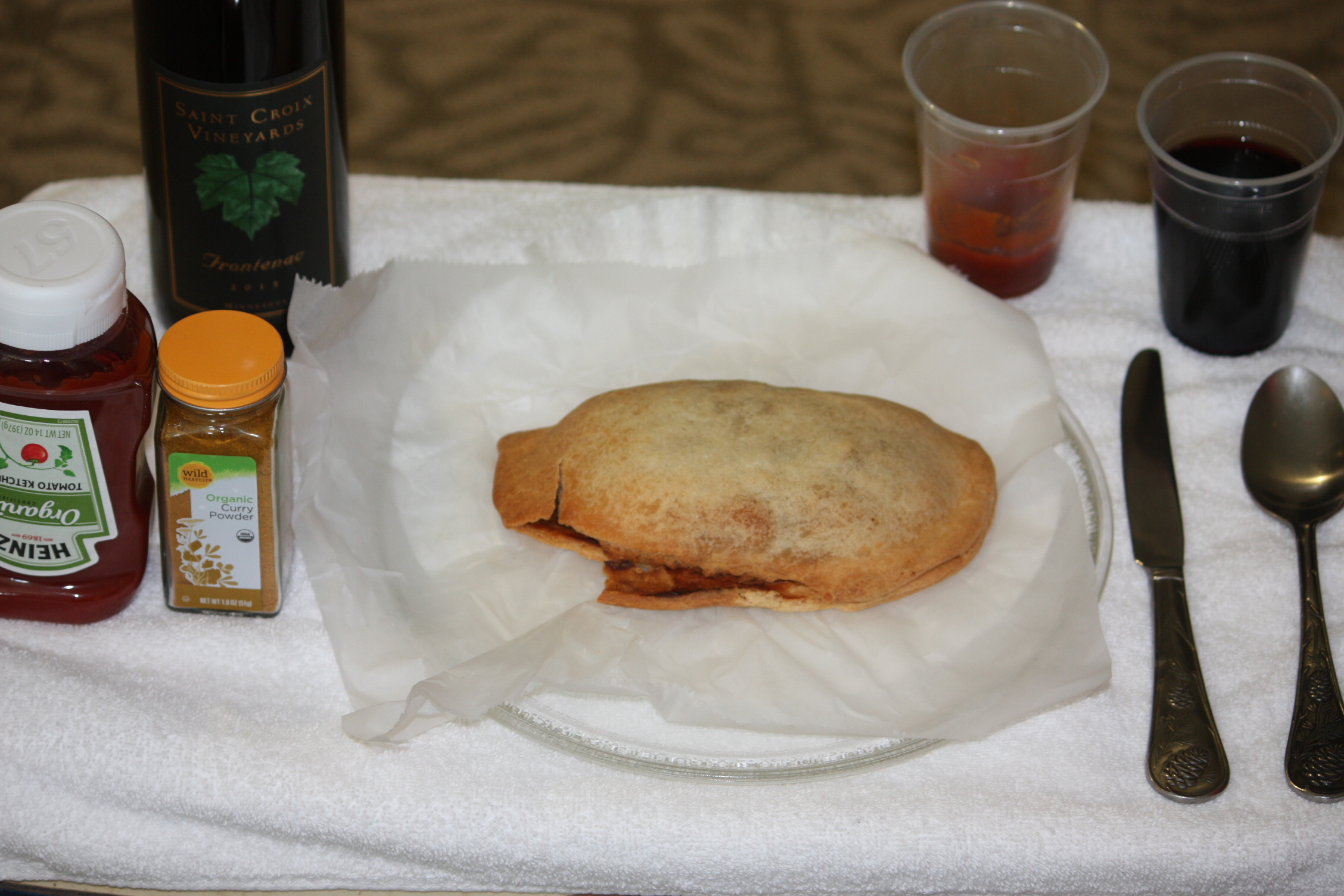
    A Cornish Pasty ready to be consumed at the Minnesota Governor’s Opener annual hunt which was held in Hinckley in November, 2018. Going on this hunt caused the author to seek out this classic miner’s lunch-bucket meal. 

    Cornwall has been the site of tin and China clay mining since Roman times. Miners working underground needed a filling meal that they could heat and consumed as they worked.  With the introduction of the potato from the New World, the result was a beef-potato savory pie baked in a durable crust. Unlike beef pies served in dishes, the pasty had to be dry enough so as not to weaken its pastry container.

    Cornish miners were highly skilled and worked in mining regions all over the world. They were in American mining camps throughout nation. Large numbers of Cornishmen and their families worked in the copper mines of the Upper Peninsula of Michigan, at the underground mines in the Iron Range of Minnesota, in the copper mines in Butte, Montana, and in gold and silver camps throughout the Rocky Mountains and California. Wherever they moved they took the favorite lunch-bucket meal with them. Pasty shops and bakeries spring up throughout the country, and a few still may be found in places like Butte.

    My participation in the Minnesota Governor’s Opener Deer Hunt in Hinckley, brought me close enough to pasty country to seek them out. The further north I drove the more people knew about them. In Hinckley there was a small bakery associated with a restaurant that sometimes made them, but had none on the shelves at the moment. I had a half-day before the events associated with my hunt would take place and I drove to Duluth seeking a walleye lunch and pasties. The following video records the result.


    As the video relates, I thought that this pasty could be improved by the addition of other vegetables, and most particularly some onions. In my own pasties I have used dark meat from bear, deer and geese for the cut-meat base. Another version might use pork, turkey or fish for progressively milder-tasting products. For vegetables I really like to add English peas, rutabagars and turnips along with some carrots. I could even envision a sweet pasty with pork and sweet potatoes and maybe a pepper or to for a mild kick. The potential variations in this product are almost endless.

    Minolta DSC
    Three of the author’s bear meat pasties. I have a YouTube video on how to make them.

    One could also change the size and instead of the standard 8-inch version offer a smaller 6-incher for hand-held eating and a 12-inch family sized variant. Because all of the components are pre-cooked prior to adding to the crust, the cooking time is just that needed to solidify the bread product. I like to use a worked slightly salty wheat flour biscuit dough for the crust to provide a durable product. The more you work the dough the tougher it becomes.

    RunzaFoodGroup[1]

    There are similar competitive products. The best known are the Hot Pocket series of crust-enclosed meat and cheese pies. Another is the Runza brand of products which are ground beef with onions and cheese encapsulated in a soft bread, as in a dinner roll.  A similar type of product is a kaloche which is of central-European origin and was brought to the America’s by Czech immigrants. Perhaps the best examples of these are from the town of West, Texas.  In popular knowledge the best known somewhat related product is the Italian calzone, made famous in the line from The Godfather, “Throw away the gun and take the calzone.” However, calzones are cheese filled, rather than have a meat and vegetable filling like the pasties.

    Ham Jahapenia Kolache

    A West, Texas, Kolache that is filled with ham and peppers along with perhaps a touch of cheese served baked inside a soft roll. These are sold in many variations and might include eggs and a sweet version that contains apple-pie filling.

    There is room in the food market for pasties made with a variety of fillings, in different sizes and served with different tomato, mustard and horseradish based sauces.  There are sufficient options in the selection of ingredients to even offer a good-tasting vegetarian product without the traditional meat fillings. The size of the establishment that might offer pasties range from food trucks to sit-down eateries to commercialization for sale in chain grocery stores throughout the world.

    If anyone wishes to contact me about them they may do so using the following form. This is but one of many business concepts that have developed by using the concepts outlined in my new book: Create Your Own Job Security: Plan to Start Your Own Business at Midlife which may be ordered below.

    Go back

    Your message has been sent

    Warning
    Warning
    Warning
    Warning

    Warning.

    Create Your Own Job Security

    Generally available for special promotion price of $10.99.

    $10.99


  • Job Options for Laid-Off Sears and K-Mart Workers

    Hovey as news anchor


    If you are a Sears or K-Mart employee and are facing the eminent loss of your job, you are joining tens of thousands of retail workers who have been impacted by changes in consumer shopping habits, on-line retailing and the availability of lower costs goods and services offered from foreign companies. Although of little consolation to you, you are not alone. Just a few months ago Toys-R-Us shut down all of their North American Stores and dismissed 10,000 workers. This trend is expected to continue as more retail outlets vanish from American cities.

    Say you were already tripling-up to live in an outrageously priced studio apartment in San Francisco, L.A., New York or Seattle, how are you going to come up with your share of next month’s rent? Other retailers are staffing up for the Christmas season, but those jobs are only going to start in December and end in January. What then?

    Start your own businesses to raise money you need when you need it.

    The concept of starting a business may be strange to you, but it should not be. Each time you have ever sold anything to anyone else or collected money for mowing a lawn or taking care of someone’s child or pet, you have engaged in a business transaction. Declaring a business and running it is only doing the same sort of thing on a regular basis for a set fee. Being paid for services, things you sell or for knowledge is money received from a business transaction and spends just like that received from a paycheck – except that you determine the frequency and amount that you get paid.

    How do I know what business to start when?

         Selecting an appropriate type of business at whatever stage you are in your life to accomplish immediate and long-term goals is what I discussed in my new book, Create Your Own Job Security: Plan to Start Your Own Business at Midlife. In this book I advocate starting a series of businesses throughout your life to do what you need to do at the moment, say raise cash for the rent, while you plan to get the degrees, certifications, etc. that you need to become an independent trade or professional business owner. Ultimately you can discover a business that you love so much that you would do the work even if no one paid you a cent. This “business of passion” may not be what you think of immediately, but you can discover, maybe over some decades, how to make money at it and let that business become your older-age business to carry you through the remainder of your life.

    Now you can raise some money by selling some things that you own that you will no longer use. Yes those items are neat, were nice to own; but you really don’t have to have them to survive. Instead of taking them to a pawn shop, set up an account and sell them on E-bay. If you had a childhood collection of something, now is likely the time to sell it off. Become a world-class expert in that class of object and E-bay selling that can be part of your building an on-line business.

    Things not to do are to pile up credit card debt or go to pay-day lenders or lawn sharks. If you must borrow, try to do it from family to help get you over a hard month or two, but keep thinking about ways that you can make some money on your own by investing in yourself.

    This may be through some training that is offered as part of your severance package. This company training will be most often focused on your finding another job rather than starting your own company. Some companies will also offer an hour or so of mental health support which is useful in helping to understand the psychological trauma that you are going through.

    Losing a job is more than losing a paycheck. It is breaking relationships that you may have developed over decades. These relationships are not only with your former bosses and coworkers it is also with the customer contacts that you developed. The result is like having a close relative unexpectedly pass away. There will be grief, questionings as to what degree do you bare personal responsibility for the business failing and the feeling of being thrown out of your own home by a parent. No wonder that you can’t think of any good business opportunities at the moment.

    This is where the planning part of my book’s sub-title comes in. I advocate that you plan and actually start your business while you are still working. This way while you are working you have your business already going, it is generating a small amount of income, and should you become unemployed you only need to energize your fledgling business to the level of profitability that you can live on. 

    What might such businesses be?

         Selling product and customer service are the two aspects of retail trade. Which are you most adept at? Perhaps you are more interested in the people who come to you for recommendations on what product to buy, than the details of the product itself. If so, you may have some undeveloped tendencies to be a personal consultant to help people get over some of life’s adverse experiences, such as working as an insurance adjuster. This type of job pays well, but requires directed training which is often given by the insurance company. What you must bring to the table is a good grasp of basic math, the willingness to make informed decisions based on evidence and, most of all, a willingness to strictly follow company policy. Ultimately each claim will be examined, and if yours are too much outside of the norm, you will be reprimanded.

    On the other hand if you had more of a mechanical interest in what you were selling than in the people who might be buying what was in your department, perhaps you are the same sort of guy who likes to invent things. Maybe you want to build a forge and make custom knives, like I do. Maybe your concept is of such practical use that you will file for a U.S. Patent. Making the product and selling it can be your new business. I also explain how to do a U.S. patent applications and secure copyrights and trademarks in Create Your Own Job Security.

    Retail sales also have aspects of marketing and advertising. Maybe you were one of these folks. There is always demand for people who can write good ad copy, come up with advertising themes and derive novel ways to attract the public’s attention. The transition to one’s own company could be to set up an ad agency and gather your own clients who might be in a similar industry or something altogether different. Or, it might be to write that novel, book or play that has been stewing in your mind for years, that you never put on paper.

    Advertising your business

    YouTube videos are a practical way to promote an advertising firm or any other creative activity. No other media allows you to have a world-wide reach, say exactly what you want, cost almost no money to produce and stays up forever. Every creative person should have their own YouTube channel featuring the products, how they are made, there significance to the world and aggressively market themselves on this media. I do as I say, and I have over 700 YouTube videos up at the moment with about 4,000,000 hits and 5,000 followers. As you are likely much younger than I am and more in-tune with the present generation, you can do much better that me.

    Overcoming the fear of failure

         There is no reward without accepting some degree of risk. Your immediate task is to discover a legal business enterprise that will return a maximum amount of income with minimal risks. Some things may fail because of changing fashion trends, adverse legislation, unforeseeable price hikes in raw materials or technological changes that may be completely out of your control. Prepare to be flexible and be able to alter the course of your business to take advantage of new opportunities as they arise.

    “There is nothing in human experience that cannot be turned into profit by an inventive mind.” This is a Hoveyism that I have derived from personal experience. If you look, opportunities are there. You may have to move to another city to get pay-check work, but if you develop an on-line business you can conduct a million or billion dollar business from anywhere in the world. Maybe some ideas will not pan out or develop as fast as you hoped. In that case put those on the back burner for more development and try something else.

    Being in and staying in the game will bring more opportunities, some of which will be completely unexpected, and you learn from each failure and build on that failure towards your ultimate success. There is no shame in the business world in having tried and failed at a business venture. There is shame in having a good idea and having someone else develop that idea before you did. Yes, you could have done that; but fact is that you didn’t and someone else did.

    Act and act now.

         “Ideas without action have no value.” I have used this statement many times in my business presentations because it is absolutely true. If you can’t or don’t act, then you are opening yourself up to responding to chance happenings that will control your life, rather than you running it. As conditions become more financially stressful, you may be forced into doing actions that you would never have considered before and will regret forever.

    A better option is to start building opportunity for yourself by thinking about, investigating and starting your own businesses, even in a small way, rather than being bounced around like a tennis ball being hit back and forth by the pressures of life.

    Start with my book and videos. 

         Create Your Own Job Security: Plan to Start Your Own Business at Midlife has been out for only a few months and has helped others turn their lives around. It can do the same for you. I also have 20 free brief YouTube videos covering different aspects of selecting and starting your own business that you can watch any day. I can also work with your directly. On my blog www.createyourownjobsecurity.com, I have an option where you can consult with me on specific topics. If you want to learn how to make and post videos as I do, I teach this for $1,000 which includes a three-day stay with me here in Central Georgia while I show you the techniques and help you launch your first YouTube video about yourself and your product or services.


    Create Your Own Job Security

    Generally available for special promotion price of $10.99.

    $10.99


    Go back

    Your message has been sent

    Warning
    Warning
    Warning
    Warning

    Warning.


  • Offer a Variety of Materials at Book Fairs

    Frog who would stop winter

    Sketch for The Frog Who Would Stop Winter one of the children’s stories that I will be offering to publishers at the Frankfurt and Miami Book Fairs.


    If you are an author and have only one book, or one variety of books to offer, you have a fairly simple choice as to how to plan your attendance, finding who to see, etc. Because I am writing and have written a variety of fiction and non-fiction materials, I need to  contact a wider variety of publishers. I have, for example, a group of children’s stories that I self-published in the 1980s that never went anywhere. Below is one of four that I am working up for the Frankfurt and Miami book fairs.

    The general plan is to take one printed copy of the four stories and take an additional copy on a thumb drive. If a publisher wants to read them at the event, I will allow them to make a copy from the thumb drive. Most will glance though the materials and want to have them submitted via. email on one of their standard forms. Few of the thousands of industry attendees want more books or bulky handouts to take home.

    Besides the one below the other stories are: War of the Spotted Ants, Alfred the Purple-Horned Snail and The Not So Goody Gum Drop Shop.

    The Frog Who Would Stop Winter

         K-thump, k-thump, k-thump, boom, splash. K-thump, k-thump, k-thump, boom splash.

    The call for a frog assembly echoed across Frogdom Swamp. Only once, years ago, had a meeting of all the frogs in Frogdom been called to drive away a predatory alligator. As each frog hopped and swam towards the great cypress stump, they asked, “What is wrong? What new peril faces Frogdom?”

    From the dark reaches of the back swamp came the bullfrog clan. The tree frogs came from the forest and even the toads came out of their burrows. All of the frogs from all the clans gathered, and before long frogs were all that could be seen from the top of the cypress stump.

    There were huge bullfrogs, medium-sized frogs, small frogs, baby frogs and even tadpoles forming a living blanket covering every inch of water, log and brush. So closely were the frogs packed around the stump that frogs were sitting on top of frogs that were sitting on top of frogs.

    The swamp rang with the sound of frog voices. There was the deep base of the bullfrogs, “K-Boooom.” The twitter of the tree frogs, “Tweep, a-tweep, a-tweep,” and the croaks of the toads, “Croaaaaaaak.”

    Still the question on every frog’s lips was, “Why are we here? What is wrong?” was thus far unanswered.

    “Boom, Boom, Boom, – Boom, Boom, Boom.” The call for silence came from the largest of all the frogs sitting on the top of the cypress stump. All voices stopped and all eyes were turned to see Phidias Frog, the largest frog in Frogdom Pond, sitting on top of the stump.

    “My friends. Fellow inhabitants of Frogdom. We are in grave danger, but I have thought of a way to avoid it and bring a time of joyous plenty to Frogdom. Will you let me speak to you on this matter?”

    “Speak. Speak. Speak,” the frogs replied in their different voices. “Speak. Speak.”

    “Now it is summer and a time of good living. Our stomachs are full and our young are growing stronger every day. Soon winter will come and all of this will change. It will become cold. Frogdom Pond will freeze, and we will have to borrow deep into the mud to survive.

    “If you elect me king, there will be no more winters in Frogdom. Think of it. Every day will be summer. Our young can grow up without danger of suffering from winter’s cruelty, and no more will be have to fret about being safe from winter’s frigid blasts.

    “What do you say? Elect me King, and there will be no more winter forever.”

    From thousands of frog voices came the cry, “Yes. Be our King, King, King. Save us and be our King, King, King.”

    But Leopard Frog, who had seen many winters come and go, was silent. He climbed high on the stump to attract the attention of the other frogs.

    “All of frogdom. Listen and hear what I have to say,” Leopard Frog shouted.

    When the noise quieted down, Leopard Frog began to speak. “I am an old frog. In my years, I have seen much, heard much and learned much. There is no way anyone can stop winter from coming. You are being tricked. You are being fooled.”

    “Boo! Boo! Boo!” came the reply from the throats of thousands of frogs as the shouted down Leopard Frog’s unwelcomed news. Hardly a single one would pay attention to what he was saying. He attempted to speak once more, but is voice was lost in the clamor.

    Phidias Frog sat on top of the stump and smiled because he felt sure that he would soon be king.

    “My friends. My friends.” Phidias Frog said. “From the deepest part of my red-beating heart, I thank you. Let me tell you how I will forever banish winter from Frogdom, and if my idea is pleasing, you can elect me king.”

    “Yes. Tell us. Tell us.” The multitude of frogs replied.

    “Everyone knows the 12 months of the year bring six months of winter and six months of summer,” Phidias Frog began. “If we want to do away with winters, all we have to do is to change our calendars. We will keep the months of April, May, June, July, August and September. We will forever remove from the calendar the cold months of October, November, December, January, February and March. If we do this, winter will be gone forever, and cold weather will never return to Frogdom.”

    “Hurray. Hurrah. Hurray. Hurrah for King Phidias frog. Hurray. Hurrah.” Came the reply from the bullfrogs, toads, tree frogs and all the other frogs at the meeting.

    Only leopard Frog was silent. “What foolish frogs,” he thought. “They will not let me tell them anything, if they want Phidias Frog as King, let them have him. They deserve no better.”

    Far into the knight the frog assembly continued.

    A King must have a title and so Phidias Frog became, Beloved of Frogdom, The Magnificent, The Worshipful, The Great, King Phidias Frog the First.

    A King must not work so that he can devote his full attentions to his Kingly duties. A tax of 10 percent of all the flies in Frogdom was levied for the King.

    A King must have tax collectors, ministers, servants and bodyguards, and so another 10 percent tax was imposed to support the King’s household.

    Each day King Phidias sat on top of the cypress stump passing laws and settling Frogdom’s disputes. It was not long before Leopard Frog was brought before the King for failure to pay his taxes.

    “I am told that you have not given the 20 percent of the flies that you have caught to my tax collectors,” King Phidias asserted.

    “I did not and I will not pay any such tax.” Leopard Frog replied. “I do not want you or any other frog to be my King.”

    “You have three choices. You may pay all present and back taxes and remain in freedom. You may elect to be banished from Frogdom, and if you return you will be killed. You may join me and become one of my ministers and never have to hunt flies again.

    “The choice is yours. What do you say?”

    “You are not fit to be king,” Leopard Frog replied. “You have led all of Frogdom on the path of destruction by your impossible promise to banish winter. You may have told all of Frogdom that you can prevent winter from coming, but you have not convinced me. I would gladly leave, rather than serve you.”

    “So let it be written. So let it be done. By your own words you have chosen your fate.

    “Guards, take Leopard Frog to the edge of the kingdom and set him free. If he comes back, kill him. This is the judgement of Beloved of Frogdom, The Magnificent, The Worshipful, The Great, King Phidias Frog the First.

    So Leopard Frog was banished. For a time all was well in Frogdom. King Phidias sat on his stump much of the day eating a portion of the flies that were collected as taxes. After the first four months of his reign, King Phidias became so fat that he could not move, and rolls of frog fat covered his legs and the top of the stump. Finally, he could only move his head from side to side and flick out his tongue to eat.

    As the warm days of August passed into September, the first cool breezes of the approaching winter descended on Frogdom.

    “Have faith, have faith, dear subjects,” King Phidias told a tweeping group of tree frogs who assembled at the stump at the first hint of cold weather.

    “Next month it will be April again, and warm weather will return.”

    Sure enough, September passed and during the first week of the next month the weather was sunny, fair and warm.

    “See, it is just as I said.” King Phidias proclaimed. “Winter has been banished and will come no more. Next week we will have a grand gathering to celebrate the end of all winters.”

    Word of the coming celebration was spread throughout Frogdom, and it even reached Leopard Frog who was busily preparing his winter den beyond the outskirts of the Kingdom.

    “How silly they are,” Leopard Frog told no one in particular. “How Silly. As sure as dark follows day, so will winter return to Frogdom.

    “They did not listen to my warning, and they banished me. Let them share whatever fate awaits them. I care not.”

    Obscured by dark brooding clouds, little sunlight fell on Frogdom the day of the celebration. The warm breezes turned into a freezing wind driving flakes of falling snow.

    Once again the assembly call was given. K-thump, k-thump, k-thump, boom, splash. K-thump, k-thump, k-thump, boom splash. This call was sounded with an increased urgency brought on by the increasing accumulation of snow.

    “Winter is coming. Winter is coming. Winter is coming. What shall we do?” was the urgent question asked from the mass of frogs huddled at the base of the cypress stump.

    “Go saaave yooourselveeees,” was the weak reply coming from King Phidias who was rapidly being covered by snow.

    “Let him die,” said one of the King’s fattest ministers. “He lied to us. He said that he could stop winter from coming and he did not. Let him freeze.”

    All the frogs scurried about hastily digging dens in the mud of the bottom of Frog Pond, in the ground or in rotted trees in hopes of making a shelter good enough to let them survive the deep cold that was coming.

    Only two frogs, King Phidias and Leopard Frog did not take part in this frenzied activity.  A tree frog, hurrying to find a warm place to spend the winter deep inside the hollow of large tree, told Leopard Frog of the happenings in Frogdom.

    Leopard Frog, cozy in his den, at first thought that the former King of Frogdom had received a just reward, but the more he thought about the King’s fate the more troubled he became.

    “King Phidias was not all bad, and no frog deserves to die alone in the cold,” he thought. “I must return to Frogdom and see what I can do.”

    By the time Leopard Frog arrived at the stump, snow was falling rapidly. A large rounded mound of snow on top of the stump now covered the bulky hulk of the despised King.

    “Can you move?” Leopard frog asked.

    “No. I cannn noooot,” came the wavering reply from under the snow.

    Leopard Frog kicked the snow from the skin of Phidias Frog and began to haul up leaves and mud to cover the top of the stump to protect the former King.

    “Will anyone help me save this frog that was once your King?” Leopard Frog asked. He received no answer. Not one of the frogs that passed by would lift a foot to help Phidias Frog.

    Through the night and into the next day, Leopard Frog labored to mound leaves, moss, grass and mud on top of Phidias Frog to prevent him from freezing.

    He worked until a fringe of ice began to form around the edges of the Frog Pond before he fled to his own warm den.

    “Perhaps he will live. Perhaps he will die. I have done my best.” Leopard Frog thought before he drifted off into his winter hibernation.

    Spring once more brought life to Frogdom. Only a mound of mud and leaves on top of the cypress stump was left as a reminder of the reign of Beloved of Frogdom, The Magnificent, The Worshipful, The Great, King Phidias Frog the First.”

    One day the mound stirred and a loud k-booooom was heard. Out from the mud and leaves emerged a leaner Phidias Frog.

    He found Leopard Frog at the edge of Frogdom Pond and said, “When no other frog would do anything to help me, you did. Why did you save me?”

    After a long pause, Leopard Frog Replied, “For good.”

    “For good? Is that all you have to say?” Phidias questioned.

    “Great good and great evil can be done by kings and governments. Sometimes even trying to do something on which nearly everyone agrees can have a bad ending. Nonetheless, solutions to life’s problems should always be sought, even though many will not succeed.”

    Create Your Own Job Security

    Generally available for special promotion price of $10.99.

    $10.99


  • If I Don’t Read Books, Can I Write One?

    Stonewall Press author with book and plackard

    Variations on this headline are the most common Google search item by would-be authors. To those of us who have been in the game for decades and seen the sales of our books steadily decline, this is a disappointing reveal. The rise of screen devices has made us increasingly a nation of non-book-readers. Yet many in this same population who will go to extreme lengths to avoid reading a book, or will at best skim it, want to write a book.

    The straightforward answer to this question is, “Yes you can.” A book is mechanically a collection of words on paper, and if you work at it, you can put 40-50,000 words on paper, self-publish it and have a book. The next question is, “Will it be worth reading?” followed by, “Can I sell more than a half-dozen of them?” However, before getting to these  questions the decision has to be made on what the book will be about.

    Fiction

    Most fiction is based on some elements of truth and will often will incorporate experiences from your own life. If it is a straightforward rendition of your life experiences this becomes an autobiography and should not contain fictional elements or characters. Should you want to mentally rework your life experiences by using made-up characters that represent the person or people you wish you were who had the experiences that you wish you had, this becomes a fictional novel, detective story or fantasy. If you also have the ability to draw, these might become children’s stories. Decide what you want to write, buy some books that represent your selected type of material, study them to see how they are organized and do something similar.

    Whatever path you start out on, finish it. Do not write a chapter of this, a chapter of that and then hope to put it together into something meaningful somehow. This is not likely to happen. Do an outline of your fictional work, plan for a climax in the next to the last chapter and plot out the problems that your characters will have along the way as they journey through the novel.  Your first efforts are likely to be terrible. When the book manuscript is finished put it aside for a month, read it critically, and see how you can improve it to make it more exciting by giving your characters some real and consistent traits to make them believable. You learn to live in your characters and understand them and their motivations. Put it aside a month and read it again. If satisfied you can submit it to publishers and wait for the rejection notices to arrive. However good your mom or aunt thinks it is, in the publishers’ world everyone has a book, and very few indeed are worth reading.

    There are many companies who offer assistance to would-be authors who will, for a fee, edit, design and publish your book. Think about $10,000 here for the full-blown treatment. They will put it on Amazon and you may wait breathlessly as two or three sales come in a month. You must aggressively publicize your new book child in order to give it a ghost of a chance of succeeding. More than 80 percent of the books on Amazon sell fewer than 100 copies. Book marketing is more significant in having a successful book than book writing. There are many well written and well published books that go nowhere.

    Nonfiction

    As a non-book reader and would-be writer, your nonfiction title should be something that you are so passionate about that you feel that the world needs to learn about it. This can be, and commonly is, personal experience as you go through a near-death experience through some traumatic event or disease. Perhaps it is a partial solution to a real-world problem like dealing with drug-addicted teens or escaping from a desperate condition in Africa or the Middle East and what was experienced and what was learned from these horrific events.

    Maybe your non-fiction book teaches a skill or trade. Perhaps it captures some unique family recipes. It could even record some little known historic events that took place in your community. All of these are aspects of non-fiction writing. If you already have a user base developed from performing on stage, in film, or have had successful records, or through making specialized products your book can sell to this audience. Commonly writers of newspaper columns will collect their best and market these in a book, although this market is getting slimmer every day.

    Is there some aspect of life that you know very well that you can impart to others that will improve their lives? If so, write about it. If your projected market is small, consider e-book publication as a way to get your information to the public without the costs of doing a softcover or hardcover book.

    Publishing houses have become very selective about the topics that they publish. Some have a particular presentation of the material in the way they format their books, such as the  Books for Dummies series. If you pitch to them, you must write according to their exact requirements.  As discussed above, pick your topic, gather your resources, outline the book and write it.

    How To Write a Book

    Putting words on paper was the traditional way and some authors still like the feel of scratching on a paper with a pen or pounding on a typewriter. Having produced manuscripts both ways, I and almost everyone these days writes using a word-processing program on a computer. Microsoft Word is the present worldwide standard, and if you are going to write and edit a book-length manuscript you should purchase a copy.

    Pick a time of day to write, and write every, every day. I do my creative writing from 2:00 AM to typically 5:00 AM, eat, nap and resume again as I work through a book. If you are working and have a family this becomes more difficult. Nonetheless, carve out some time for this tasks, shut off the TV, radio, cut out the music, kill the cell phone and write. The best way to work through a book faster is to thrown the TV out  of the house. You need to be creating; not just reacting to someone else’s brainchild.

    It makes no difference how much you write each day, but write something. It is not unrealistic for an author to have a goal of four finished pages a day. You are not going to write a book at a sitting.

    The Biggest Hurtle

    While many think about writing a book or perhaps are told by others that they should, the biggest hurtle is actually committing to the project and getting started. You do not need to be blessed by the writing gods, and you do not need permission from anyone. All you have to do is sit down and write.

    Create Your Own Job Security

    Generally available for special promotion price of $10.99.

    $10.99

    Go back

    Your message has been sent

    Warning
    Warning
    Warning
    Warning

    Warning.